Category: Strategy

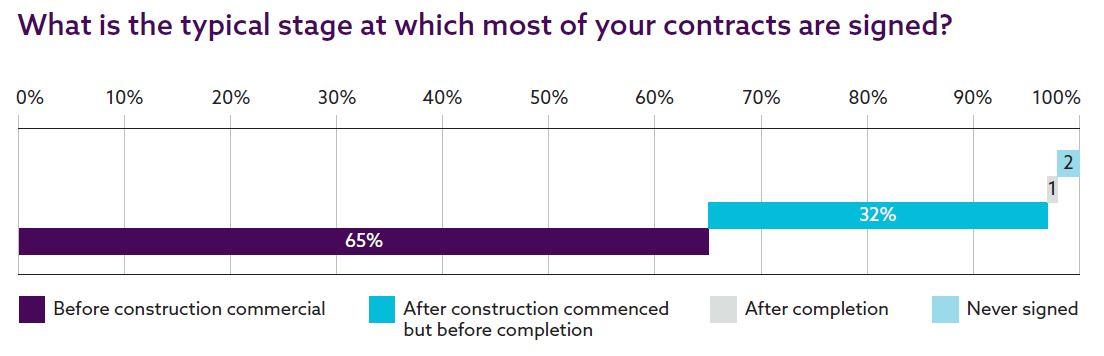
An image from the NBS National Contracts and Law Survey 2018 showing the typical stage at which most of the respondents' contracts were signed: 65% before construction, 32% after construction but before completion, 1% after completion and 2% never signed.
Sarah Fox

Get it signed

Do we hate paperwork so much that we are prepared to start multi-million pound construction projects without a contract? The data The NBS Contracts and Law Survey 2018 (like its predecessors) highlights that roughly 1/3 of projects start without a proper contract being finalised. Like the 2015 survey it found:

Read More »

How can we improve T&C?

The UK government needed your help. They wanted to know your bugbears about T&C, as well as your ideas for improvement. Although legislation (the Consumer Rights Act 2015) requires T&C to be fair and transparent, the law only allows consumers to challenge those that aren’t. It does not provide direct

Read More »

Which is better: letter of intent or no contract?

Sarah Schutte of Schutte Consulting joined me at a blab debate and discussed whether a letter of intent was better than ‘no contract’. We covered: the requirements for a contract, the critical contents for a workable legally binding letter of intent why bother with a contract, how a letter of

Read More »

Review the risk in using a letter of intent

Although there are a number of pitfalls with letters of intent, the key risk is that the full contract is never signed. A letter of intent is used to get the project started quickly, but it is only intended to be a temporary stop-gap. So why don’t the parties get

Read More »
A window broken shown against a blue sky. By Skeeze on Pixabay
Sarah Fox

When letters of intent go wrong: the client perspective

A letter of intent is a contract to start a construction project in the form of a letter. It may also confirm the sender’s intention to award the contract for the whole project to the recipient – the contractor. The purpose of a letter of intent is two-fold: (1) to

Read More »

Your contract strategy should be deliberate

Contract strategy is just a fancy way of saying choosing the type of contract you want. There are various issues to take into account: your procurement strategy: traditional, design and build, prime cost, management contracting your payment strategy: lump sum, remeasurement, target price your risk strategy: pro-active or reactive; transfer,

Read More »

Using letters of intent

According to most professional bodies, you should ‘just say no’ when offered a letter of intent. However, the court recently said that it was not negligent to start a project under a letter of intent. So what advice is there on using letters of intent? One case (Cunningham v Collett)

Read More »

Use LADs to compensate (not deter)

In order to avoid technical defences to an agreed level of damages (liquidated damages), you should concentrate on making sure the purpose of the clause is made really clear. Compensation In Lorsdvale v Zambia, the question whether the amount was a penalty or a genuine pre-estimate was based on: “whether

Read More »

Failure is your new best friend

Contracts should help you do business. But we have to be realistic. Change happens. Risk events occur. Humans are fallible. Most contracts do not anticipate ‘failure’ in stark terms. However, not every project will be a success, especially those which are on the edges of what is currently possible. Is

Read More »