Tag: contract process

Catastrophic conditions precedent

Last week I was working with a specialist subcontractor client to improve their management of contractual risk (as their MD put it). As part of a workshop on Contract Awareness, I asked various staff to read a variety of T&C and answer questions such as: when are you going to

Read More »
A circular image showing the plan, make and use stages for contracting as well as describing some of the tasks making up those stages. The outer circle has arrows to show that this should be a continual process of improvement. Image copyright Sarah Fox
Sarah Fox

What are smart contracts?

A smart contract means a ‘computer protocol intended to digitally facilitate, verify, or enforce the negotiation or performance of a contract.’ [source] From this definition, a smart contract is just the code – it has been said that it is neither smart nor a contract! More recently, the Law Commission

Read More »

Hope is not a contract strategy

One of the key problems with contracts is knowing how and when to use them effectively. This decision should be part of a clear contract strategy. Even if you don’t have a mature contract strategy, any strategy is better than hope! As fellow speaker and internet marketing expert, Ian Brodie,

Read More »

Can you avoid letters of intent?

Whether you can avoid a letter of intent depends on where you are in the contract process – are you at the stage of deciding your contract strategy or are you about to start the construction phase? It can either be a strategic or tactical decision… Strategic If the client

Read More »
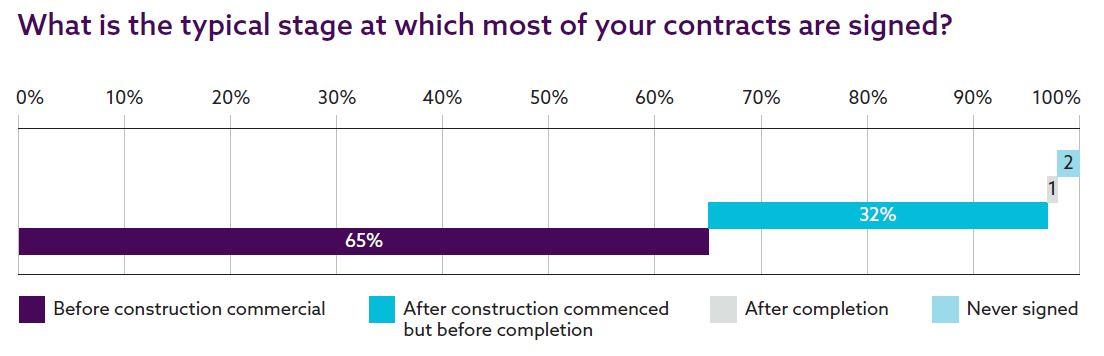
An image from the NBS National Contracts and Law Survey 2018 showing the typical stage at which most of the respondents' contracts were signed: 65% before construction, 32% after construction but before completion, 1% after completion and 2% never signed.
Sarah Fox

Get it signed

Do we hate paperwork so much that we are prepared to start multi-million pound construction projects without a contract? The data The NBS Contracts and Law Survey 2018 (like its predecessors) highlights that roughly 1/3 of projects start without a proper contract being finalised. Like the 2015 survey it found:

Read More »

What is the battle of the forms?

Since 1977 lawyers have talked about the importance in contract formation of the ‘battle of the forms’. What is this and how does it affect you if you are in business? What is ‘the battle of the forms’? Lord Denning coined the phrase ‘battle of the forms’ in Butler Machine

Read More »

Negotiate your contract

In deciding whether a clause is unfair, a tribunal will consider whether your contract partner had a choice to accept or avoid a particular term. Many years ago, a highly influential judge, Lord Denning, said: None of you nowadays will remember the trouble we had – when I was called

Read More »

What does ‘subject to contract’ mean?

Recently I came across a contact who had a standard footer on her emails, not about saving the environment but that ‘Any offers made in an email or attachments are subject to contract.’ It’s not just the lawyers who throw caution to the wind and bandy about ‘subject to contract’. 

Read More »

When is an offer not an offer?

When is an offer not an offer but the award of a contract? When its a snake in the grass? The TCC recently has to grapple with the rights of the parties under a framework agreement, in unusual circumstances. What is a framework agreement? A framework agreement normally allows an

Read More »
A close-up photo of two human hands shaking to indicate their agreement. One (my son) has a glimpse of a white shirt cuff and clear button. The other (my sister) wears a pink cardigan. Photo by Sarah Fox
Sarah Fox

Can you contract with a handshake?

As a contract drafting lawyer, you might think that asking you to consider ‘should you bother with contracts?’ is a little like asking the proverbial turkey to vote for Thanksgiving or Christmas! Construction contracts in the UK have been around for about 150 years, with published standard forms a product

Read More »